

 18.05.2026
 578 görüntülenme
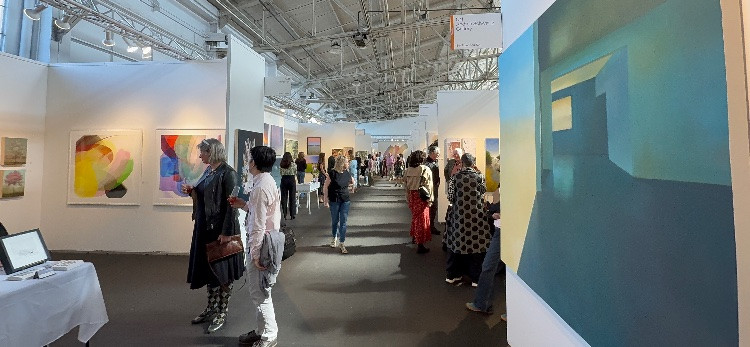
In its 2026 edition, the San Francisco Art Fair positioned itself not merely as a commercial event, but as a comprehensive model illustrating the organization of a regional ecosystem. Produced by Art Market Productions [AMP] and held at the Fort Mason Festival Pavilion, the fair maintains its continuity through a sense of institutional stability, standing as one of the [SF/BA] Bay Area’s most enduring cultural fixtures.
With a framework comprising 88 galleries and 46 cultural partners, the structure aims to transcend the classical fair model by proposing a multi–layered program. The balance struck between local galleries and national/international participants allows the fair to preserve its regional identity while seamlessly integrating into the global circulation of art. The robust representation of SF–based galleries materializes the fair’s claim of 'supporting local production', while galleries hailing from diverse geographies [such as Paris, Busan, and Cape Town] endow the structure with international breadth.
The conceptual backbone of this edition is defined by an AAPI [Asian American and Pacific Islander] centric approach. This choice is read not merely as a policy of representation, but as a curatorial orientation referencing the historical demographics of the Bay Area. Collaborations with institutions like the Asian Art Museum and Cantor Arts Center anchor the fair within institutional memory. Meanwhile, the presence of entities such as the Chinese Culture Center of San Francisco and Edge on the Square demonstrates the extent to which Chinatown–based production has been woven into the contemporary art discourse. The city’s demographic diversity in this regard is palpable from the outset, even to a casual visitor.
Another vital pillar of the program is the integration of a print fair in collaboration with Black Art In America. This section renders the work of African American artists [see also Butter Art Fair] visible through a historical lens while redefining collecting practices through a more accessible medium. By positioning print works within a more 'attainable' price segment, the fair seeks to open an alternative entry point into market dynamics.
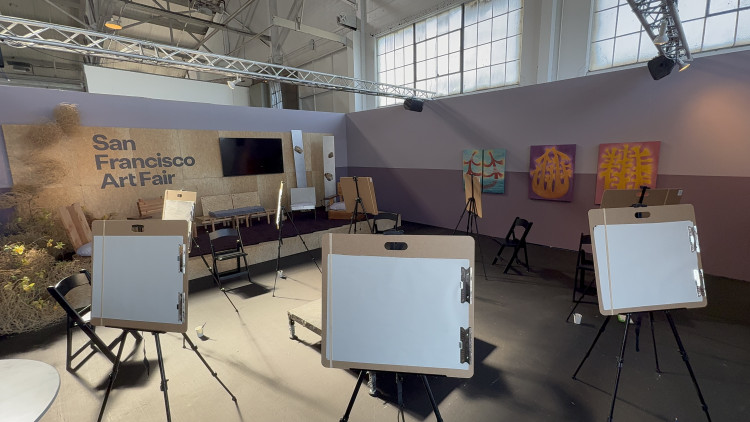
The talk program addresses contemporary art discourse through an expansive lens. Spanning from curatorial practices and biennials to the boundaries of public art and the dynamics of collecting, these panels transform the fair into a site of knowledge production [much like other fairs aiming for diverse programming]. Notably, titles such as "Whose Art, Which Public?" and "The Future of Art Spaces in San Francisco" brought critical discussions to the fore regarding the city’s dwindling art spaces and escalating costs.
Spatial design is also treated as a core component of the program. The fair theater, designed by Anand Sheth with a stage crafted from recycled materials, underscores themes of sustainability and local craftsmanship.
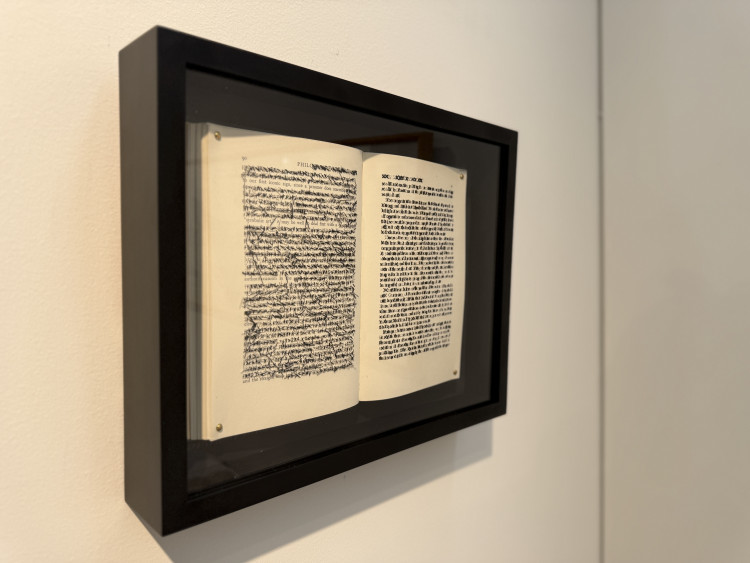
Brought to the fair via the Djerassi Resident Artists Program [curated by Mushi Wooseong James], Lauren DiCioccio has utilized 'fiber' art since 2005, not merely as a material preference, but as a philosophical medium to interrogate our relationships of loyalty and loss regarding objects. DiCioccio’s practice, characterized by hand–stitching and embroidery, acts as a silent resistance against today’s culture of speed and disposability, asserting the weight of time and labor.
In her early works, the focus lay on everyday objects that are gradually 'vanishing', such as newspapers. According to the artist, we form bonds with these objects [integral to our daily rituals] similar to those we form with humans, animating the object by imbuing it with human attributes [e.g, 'faithful, reliable']. By reconstructing these items with fabric [the most intimate texture that touches our skin twenty–four hours a day] she triggers an emotional contact within the viewer.
In her recent period, DiCioccio has moved away from external reference points [newspapers, specific objects] to pivot toward the internal momentum of the material itself [cotton, needle, batting]. The Familiars series is a product of this liberation. Working from the inside out, she twists, wraps, and embellishes the material through instinctive movements. The resulting sculptures are neither fully organic nor purely inanimate; they are figurative forms possessing their own posture and persona, evoking an 'uncanny familiarity' in the viewer.
Transcending representation, DiCioccio writes the material’s own history. Her sculptures form a family of forms [at once whimsically humorous and structurally profound] exploring the power of tactile experience and the human’s inexhaustible desire to personalize the inanimate.
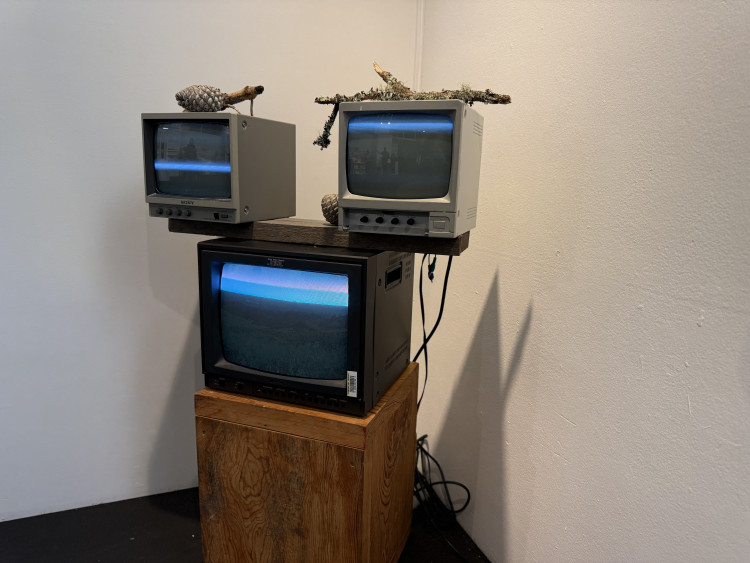
Under the same program, Barbara Nerness [00:41] merges the identities of artist and scientist with rare sensitivity. In her installation biofogback, she invites the viewer into an ecological introspection. Blending her academic depth from Stanford CCRMA and her technological prowess with natural phenomena experienced during her residency, Nerness conceives of fog not just as a meteorological event, but as 'the breath of the ocean over the land'.
At the heart of the work are GSR [Galvanic Skin Response] sensors that measure the electrical conductivity of our autonomic nervous system. Here, however, technology serves not as a cold data–collection tool, but as a bridge synchronizing human breath with the rhythm of the ocean. By discovering the sensor's specific response to deep breathing, the artist directly incorporates the viewer's biological rhythm into the auditory and visual atmosphere of the space [utilizing field recordings and CRT televisions].
The narrative of the piece began during the artist’s retreat in the hills, witnessing the fog seize the space like an unpredictable, 'shape–shifting character'. This layer of fog, which at times constricts sound and vision and at others swallows everything within minutes, allows the participant in the installation to turn inward. As the viewer dons the sensor, the distinction between the movement of the external fog and their own deep breaths blurs; the invisible tentacles of the fog touch the participant's nervous system, and by extension, their soul.
Nerness positions the human not as a detached observer of nature, but as an active, breathing part of the ecosystem. Fusing the technology–driven compositional discipline of the SF and LA art scenes with the chaotic yet mesmerizing rhythm of nature, biofogback stands at a rare intersection where technology and metaphysics are designed to meet.
The placement of the work within the booth was exceptionally well–chosen; the finger sensors explain themselves intuitively, even without text. By the time the image appears on the screen, the gallery staff has already conveyed the narrative. With its performative design that pulls the viewer into the work, it is a project that lingers long in the memory.
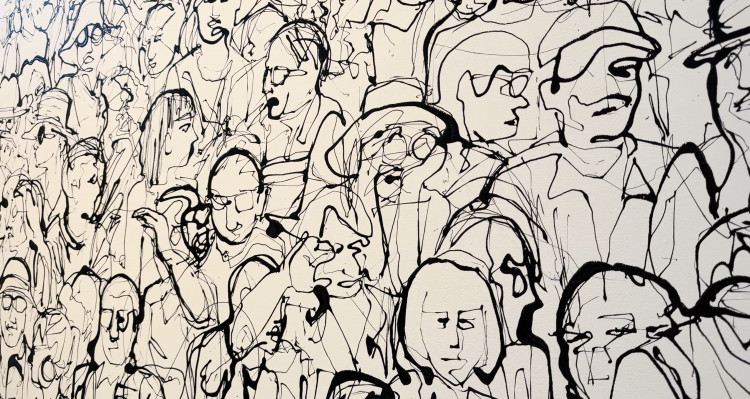
Amanda Joy Brown, whose black–and–white painting 'Music in the Park' [02:02] draws the viewer in almost hypnotically, has spent the last two decades examining the flawed nature of observation through the tense balance of chaos and control. The fluid, calligraphic 'drip line' at the center of her work possesses a dimensional character that both connects and conceals, forming both the skeleton and the textural presence of the piece. This technique, which the artist links to her practice of continuous contour drawing, transforms the calibration between hand and eye into an organic thought process.
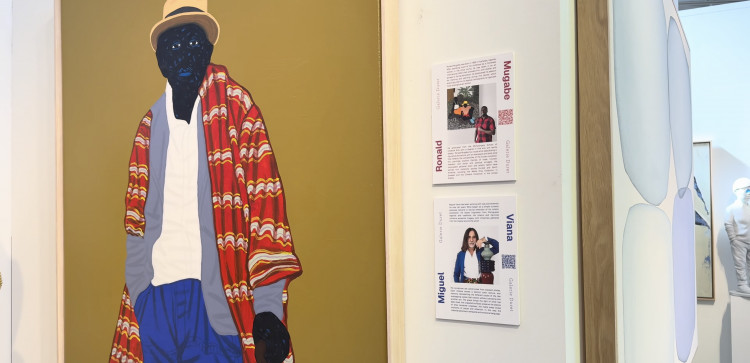
Beyond the artworks themselves, a striking detail of the entire event was the professionally prepared wall labels, notably at the booths of Hong Kong/Philippines–based [03:09] Parallel+, Paris–based [06:13] Galerie Duret, and the Chinese Culture Center [09:00] Design Store from San Francisco. During peak hours, when harried gallery representatives cannot provide sufficient information or keep pace with the visitor cycle, the detail of the labels becomes paramount to fair operations. Furthermore, while the story told to you may fade or blur with other works, a photographed label remains permanent.
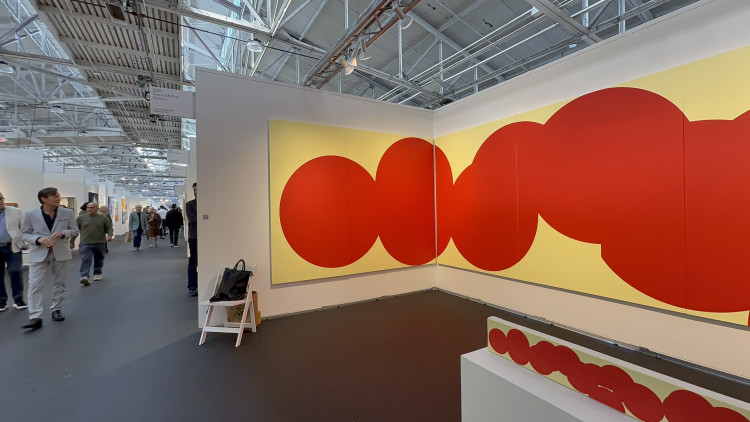
At the booth of Good Mother Gallery [one of the few institutions in LA whose interest in conceptual art I follow with great appreciation] I encountered Chad Hasegawa’s [13:41] monumental 2026 project, 'Hawaiian Love Song.' The artist presents minimalism not just as a style, but as a map of purification for experiencing the world. As the SF–based artist peels back layers of complexity in search of that delicate equilibrium between logic and emotion, he replaces narrative storytelling with the pure energy of color and form. In this process, where every brushstroke is meticulously constructed through addition and subtraction, Hasegawa prunes away the superfluous, leaving the viewer alone with their own internal landscape.
Massive works and solo–artist presentations carry various sales risks within fair dynamics. In mainstream fair practices where 'the sale' unpleasantly supersedes 'the meaning', a potential buyer may struggle to understand which parts of a multi–piece work are available, or may lose interest if a single visual language doesn't immediately resonate. As artists, we naturally do not care about this during the creative process, but I believe it serves as a useful example for explaining the circulation cycle of artworks.
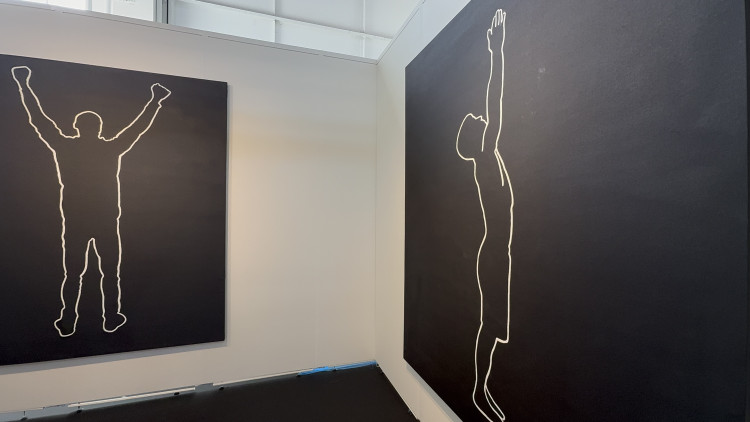
In the series 'Body Count', presented by Smith Contemporary [14:33], Todd Serlin reduces the human form to a single, continuous line, navigating the uncanny boundary between presence and absence. Carrying traces of Weegee’s crime scene photography and Richard Hambleton’s street interventions, these chalk-like silhouettes might initially evoke death, yet they aim to represent life in its purest, most resilient state. By leaving the figures hollow, Serlin anonymizes identity, confronting the viewer with the concept of "Everyone." These lines, stripped of detail, render universal themes like fear, religion, sexuality, and mortality fluid. Glowing against a light-absorbing black ground, these high-contrast, resolute lines open an active space for imagination and empathy rather than a mere void; each figure carries the simultaneous potential of being no one and all of us.
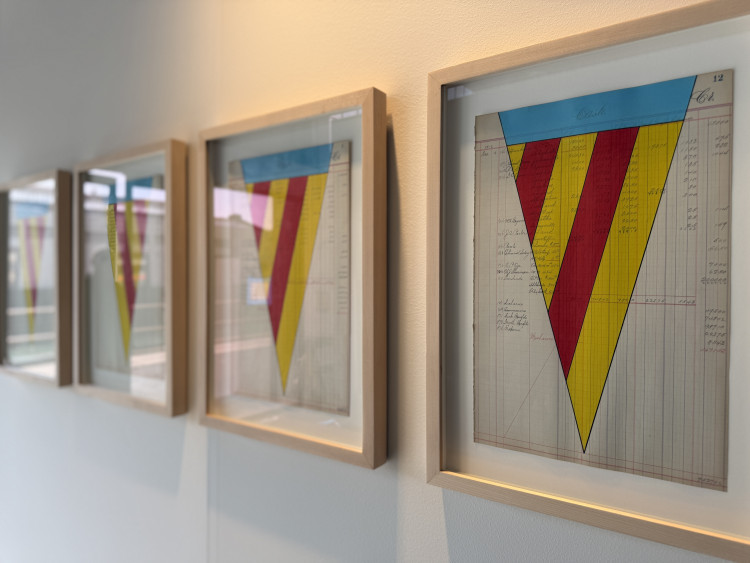
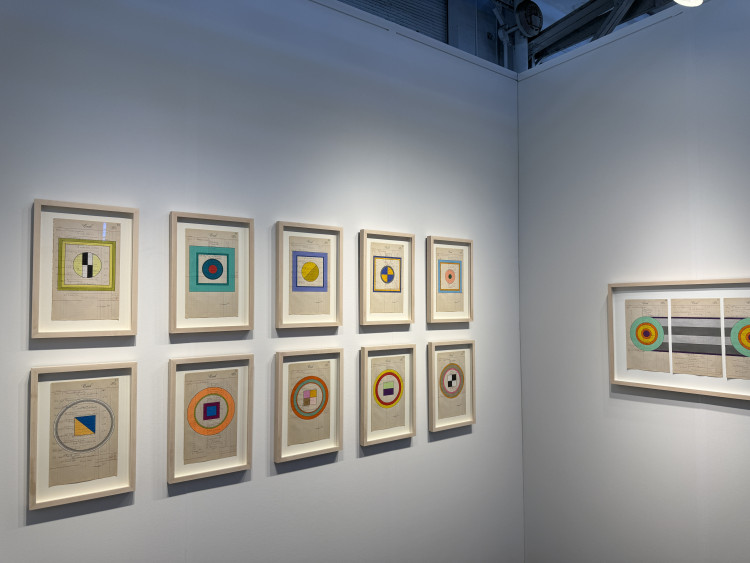
The practice of Terran [Saakwaynaamah’kaa] Last Gun, presented by COL Gallery [15:31], reconfigures visual language as a site of resistance and continuity, placing Piikani modernism at the heart of contemporary abstraction. The artist brings a ten–thousand–year heritage into the present by merging ancient geometric arrangements [representing the sky, earth, and spirit layers of Blackfoot painted lodges] with contemporary minimalist aesthetics. His use of antique ledger paper, a symbol of colonial bureaucracy and property records, as a canvas adds a profound political layer; vibrant fields of color worked over tax and debt records transform colonial memory into Indigenous visual sovereignty. For TLG, geometry is not a search for form devoid of content; on the contrary, it is a silent manifesto laden with meaning, inextricably knotted to land, cosmos, and cultural narratives.
From a managerial perspective, the fair is quite satisfyingly designed. The walking route is intuitive, allowing one to see everything without the need for a floor plan, emails are replied on time. Unlike many openings, the VIP preview offers a spacious experience that never feels stifling.
Most galleries are highly professional, bringing artists they already represent and exhibit. However, the operating principle of a few outliers is to 'sell' their rented booth space by the square meter back to the artists, effectively guaranteeing a sale in the wrong direction.
The raison d'être of a gallery is not to derive its income from fees charged to the artist; indeed, a professional gallery does not charge an artist anything beyond a commission. A gallery is obligated to organize human relationships [drawing its network of potential buyers and art lovers to its space during exhibition periods]. This is where the sale should occur, with the artist and gallery splitting the agreed–upon commission and expenses. When the opposite happens, and a gallery derives its income from the floor rent it demands from the artist, its primary purpose ceases, and the necessity to build a network, invite patrons, or facilitate a sale largely vanishes.
Yorumlar (0)
Bu gönderi için henüz bir yorum yapılmamış.
Yorum Bırakın